
EDITO Community in Action
Exploring the dynamics of tuna and planning for the future

An application now available as a demo on the EDITO platform reveals detailed information about the behaviour of skipjack tuna under different climate conditions, while offering precise understandings of marine spatial management, the effects of natural variability, and the impacts of climate change over time.
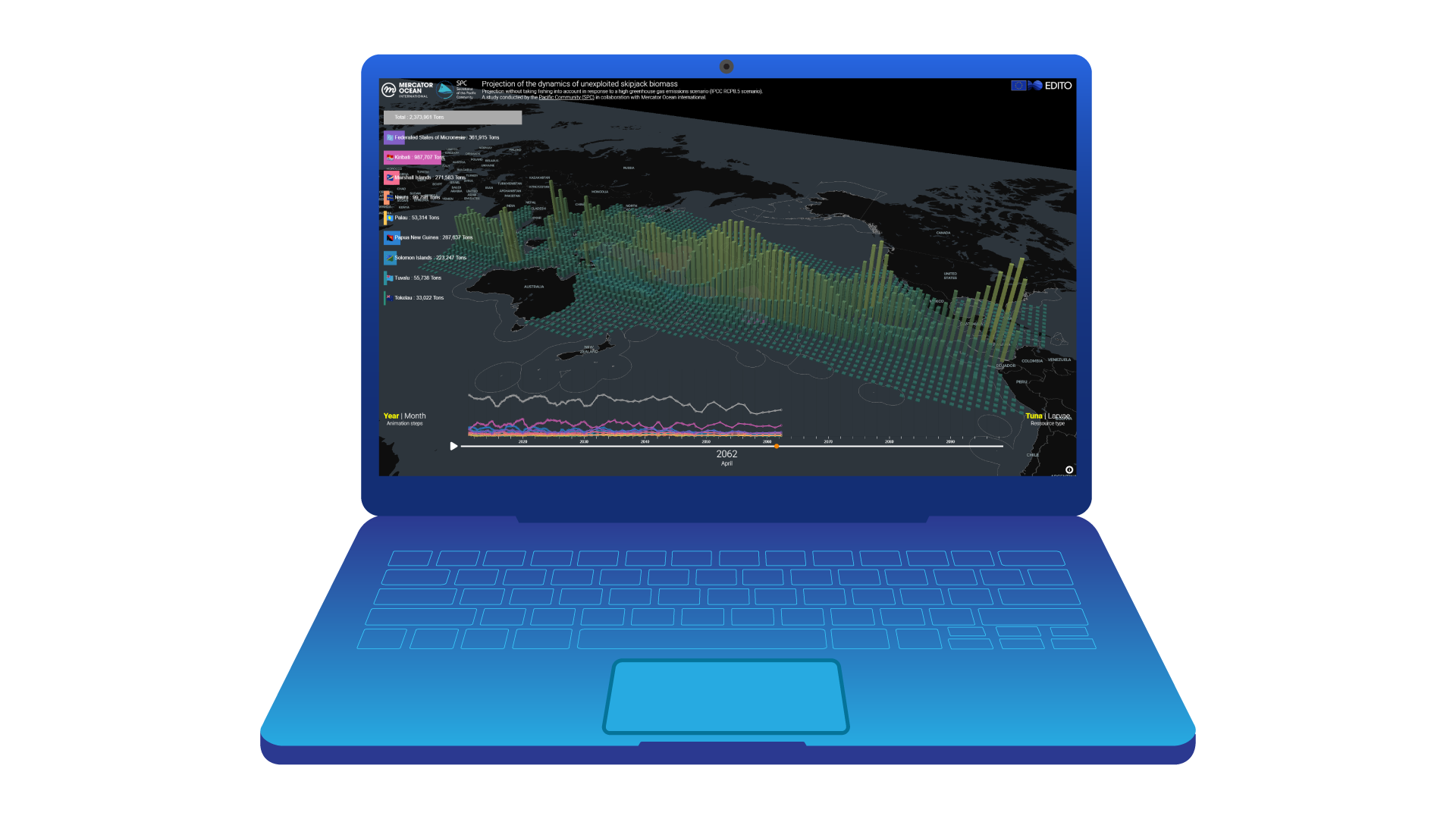
The story of what became the “Climate and tuna” application stretches back 25 years, with the collaborative development of the SEAPODYM (Spatial Ecosystem And Population DYnamics Model). This model was created to help researchers visualise the distribution, abundance, mortality and movement of tuna in the Pacific and explore how these change in relation to the environment.
“One of our main motivations for developing SEAPODYM was to study the impact of El Niño and La Niña on tuna fisheries in the Pacific Ocean,” says Dr Patrick Lehodey, a leading developer of the SEAPODYM model and now the climate and tuna app. “We were studying how such a large quantity of tuna can persist in this region.”
The development of SEAPODYM has been supported by the Pacific Community through various research and development projects over the years, with strong support from the European Commission.
By more precisely understanding the dynamics of tuna in the Pacific, international stakeholders have been able to tailor their approach to marine spatial management and grow the fishing industry sustainably.

“Today, the mechanisms that redistribute tuna in this region over thousands of kilometres in relation to El Niño and La Niña phenomena are now better understood and simulated. This is linked to the large variations in water temperature, oceanic circulation and primary productivity that feed the oceanic food chain in the central western Pacific, with phases of expansion (El Niño) and contraction (La Niña) of tuna habitats. These results have allowed Pacific Island countries to establish a mechanism for managing fisheries sustainably, even as catches have doubled since the 1990s. The Western Central Pacific Fisheries Commission (WCPFC) — responsible for managing stocks and fisheries in this vast ocean region — is showing increasing interest in using [the climate and tuna app] to support its decisions”
However, Lehodey continues, “we still struggle to understand how the region supports such a high biomass. New developments in the three-dimensional observation of the Ocean, such as the bio-ARGO profilers and the SEAPODYM modelling of low- and mid-trophic levels (zooplankton and micronekton) should help to answer this outstanding question.”
The first species included in EDITO’s climate and tuna application is the Pacific skipjack tuna. This is the most productive species, supporting the world’s largest tuna fisheries. Thanks to collaborative projects piloted by SPC with FAO and the support of the Global Environment Facility (GEF), It should be followed by the other key exploited tuna species yellowfin, bigeye and albacore, in the Pacific and then Atlantic and Indian Oceans as well.
“The Climate and tuna app provides a rich visualisation of the movement and behaviour of key tuna species. It can also simulate the projected impacts of climate change on tuna by running what-if scenarios to simulate the release of greenhouse gases into the atmosphere at different points in the future,”
Dr Patrick Lehodey, a leading developer of the SEAPODYM model and now the Climate and tuna app
Data is provided from several sources. “For this application, data related to fishery catch, size composition and, if available, tagging data are provided on request by the international tuna fisheries management organisations (WCPFC; ICCAT; IATTC; IOTC) and associated programmes involved in their monitoring and management activities (e.g. The Pacific Community),” explains Lehodey. “The environmental variables needed to run the model are generated by ocean circulation and biogeochemical models as used in the Copernicus Marine Service.”
By drawing on multiple data sources, visualising key variables and simulating different scenarios, the Climate and tuna app can be used to explore the impact of natural phenomena such as El Niño and La Niña and explore the effects of climate change in the long term.

In connection with the European NECCTON project, an additional module is being implemented that will allow for testing future fishing scenarios, that could be used to aid science-based decision making. For example, a user will be able to explore “fishing scenarios based on annual catch targets and climate change scenarios.” Stakeholders will also be able to use the app to investigate spatial management areas, such as finding the most suitable placement for a fishery or establishing Marine Protected Areas.
Once fully implemented and regularly updated to account for recent changes in environmental conditions and fishing, and progress in modelling, the Climate and tuna app will have numerous scientific and societal uses.
It will give the public a tool to discover and understand how high seas fisheries and marine resources are monitored, exploited and managed, while stakeholders will be able to quickly explore spatial management measures and potential combined impacts of exploitation and climate impact.
Dr Patrick Lehodey, a leading developer of the SEAPODYM model and now the Climate and tuna app

This work is funded by the European Union under grant agreement no. 101227771. Views and opinions expressed are however those of the author(s) only and do not necessarily reflect those of the European Union or the European Research Executive Agency (REA). Neither the European Union nor the granting authority can be held responsible for them.
Privacy policy | Cookie policy | Website by Seascape Belgium